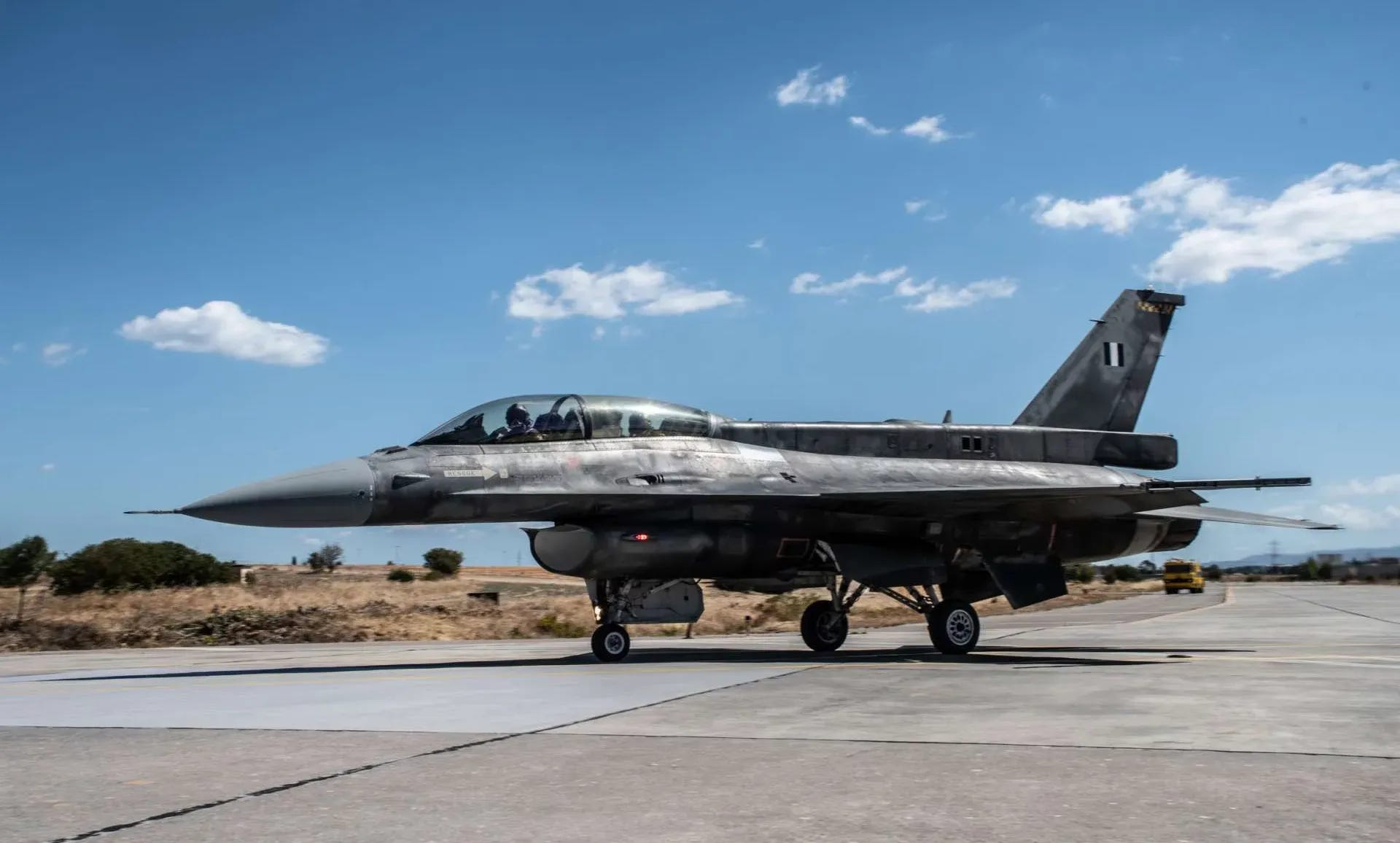
The Hellenic Air Force (HAF) and its F-16V fighter jets have featured prominently in the Greek news cycle over the past weeks following three show-of-force operations in three different corners of the Eastern Mediterranean.
September 27, 2025: South of Crete:
An F-16 scrambled from the 115 Combat Wing, stationed in Souda Air Base, Crete, performed a low pass over the Sumud Flotilla vessels and a Turkish warship escorting them until their entry into Greek territorial waters. Contrary to the popular framing of the incident by the prevalent algorithm-boosted chatter on X/Twitter, the F-16 did not seek to intimidate the Gaza flotilla but deter the Turkish warship from violating Crete’s territorial waters.
Nevertheless, the civilian fleet’s movements were exploited by Ankara to manifest its “Blue Homeland” disputes against the extent of the Athens Flight Information Region and the overlapping Greek Search and Rescue Zone (SAR), as the Turkish Navy’s presence south of Crete and drone activity east of Crete and the Karpathian straits showcased. As is customary in Turkish practice, the UAVs did not submit flight plans upon entering the Athens FIR, prompting HAF to scramble F-16s for interception. The UAVs, which reportedly consisted of an Aksungur, Akinci and a Bayraktar TB-3, were all unarmed.
The Greek authorities’ decision to limit the flotilla’s monitoring to just 6 nautical miles off the Cretan coast, rather than throughout the full extent of the Greek SAR zone in the area, effectively allowed Turkish forces to attempt to usurp that responsibility.
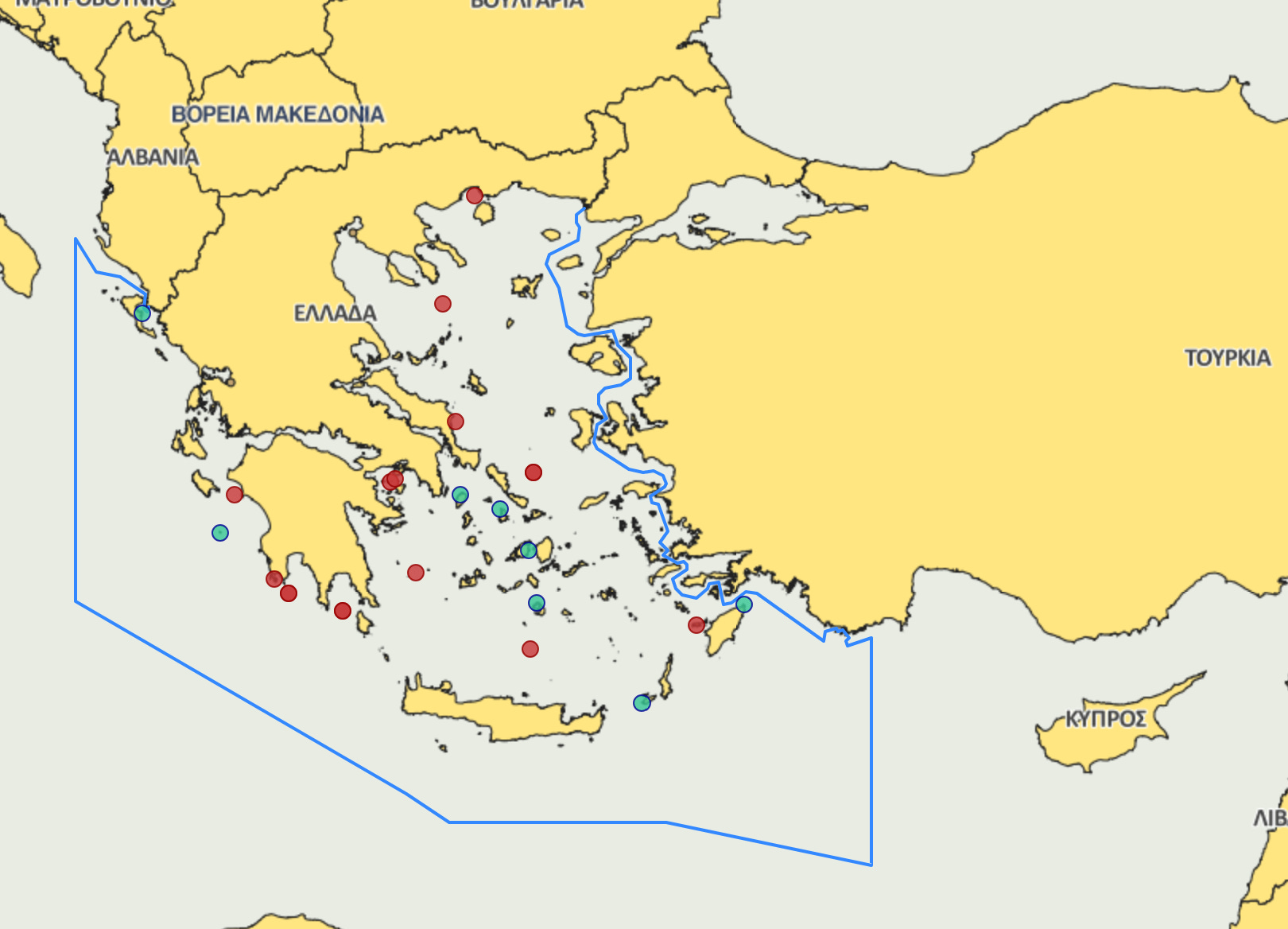
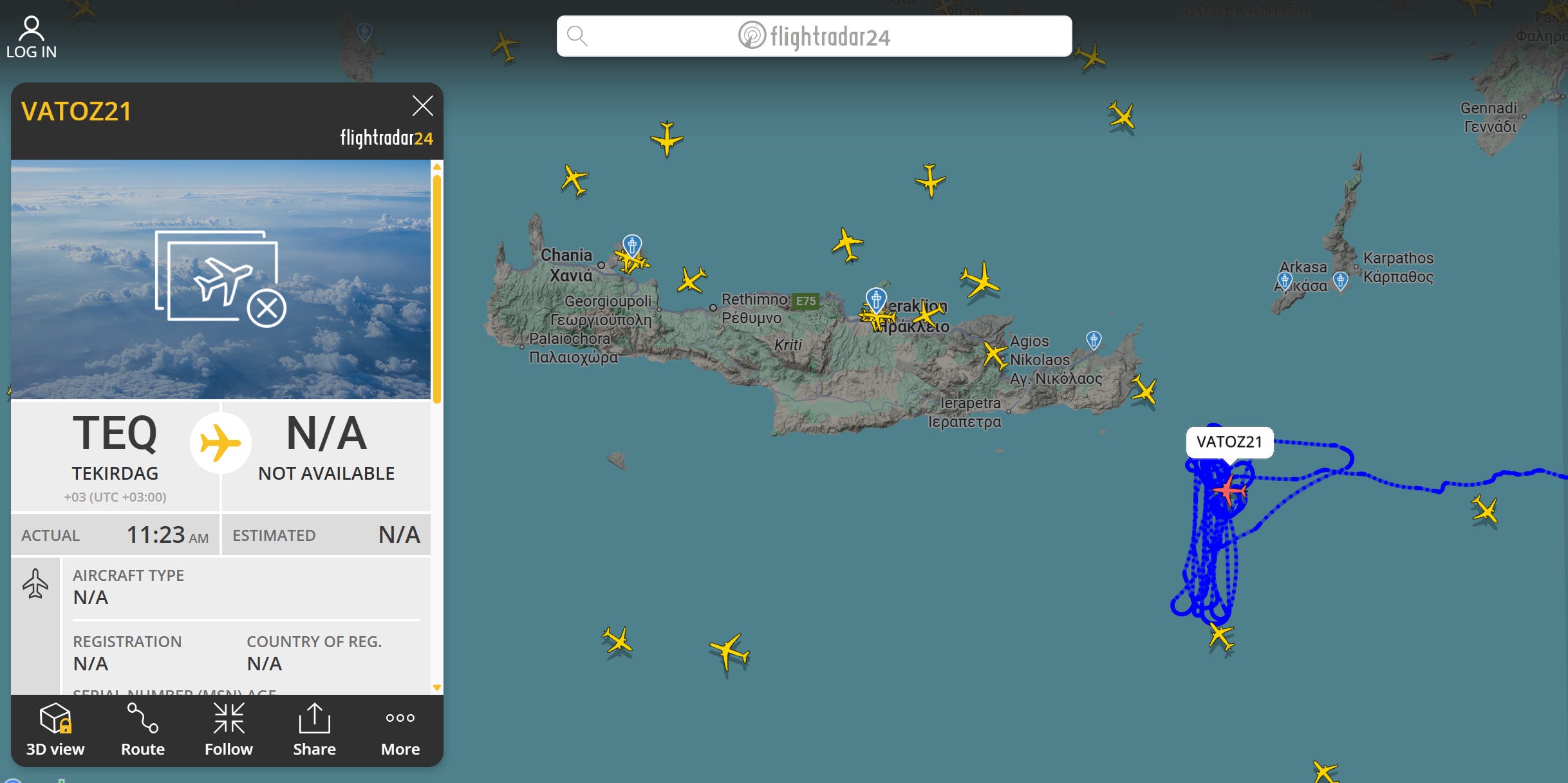
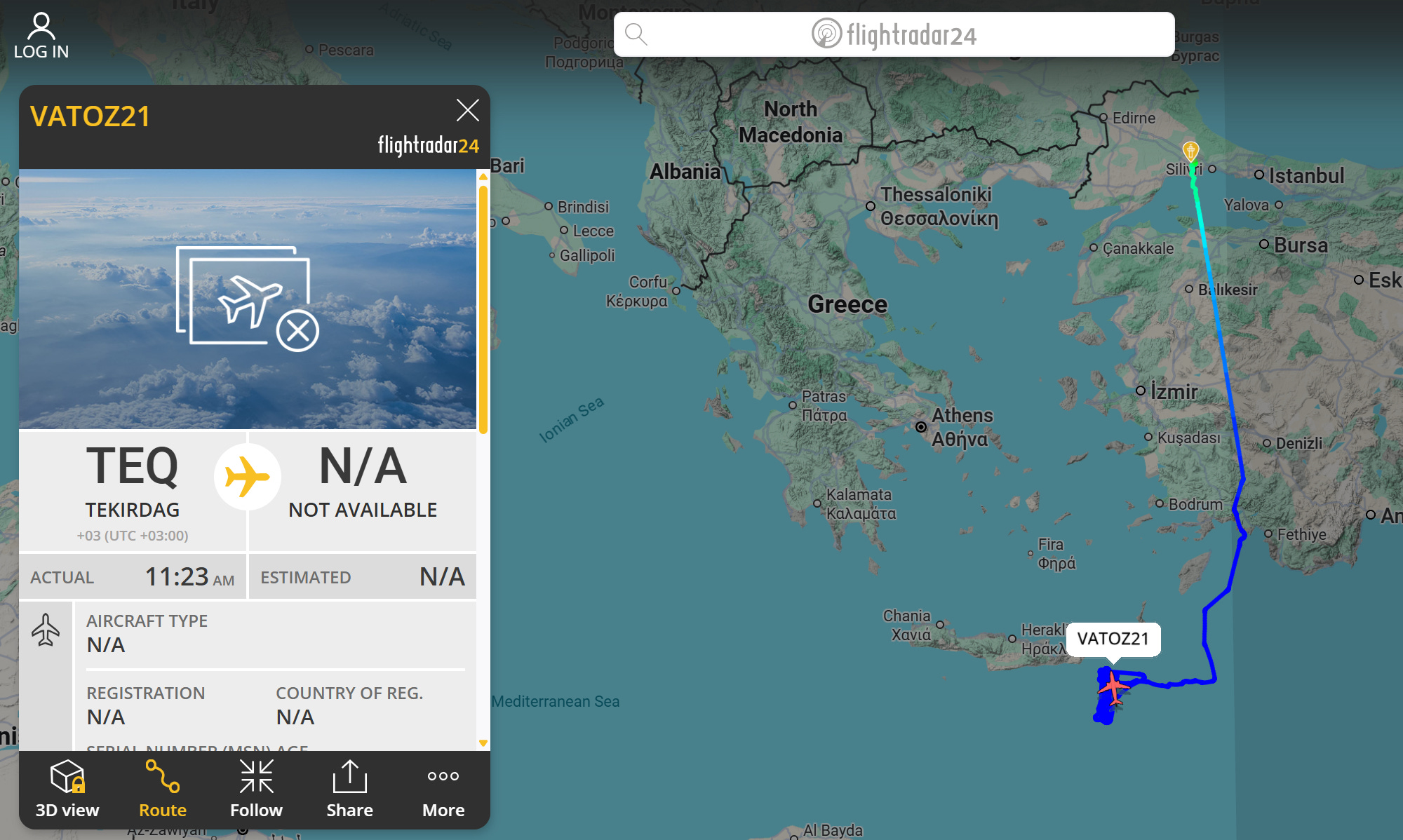
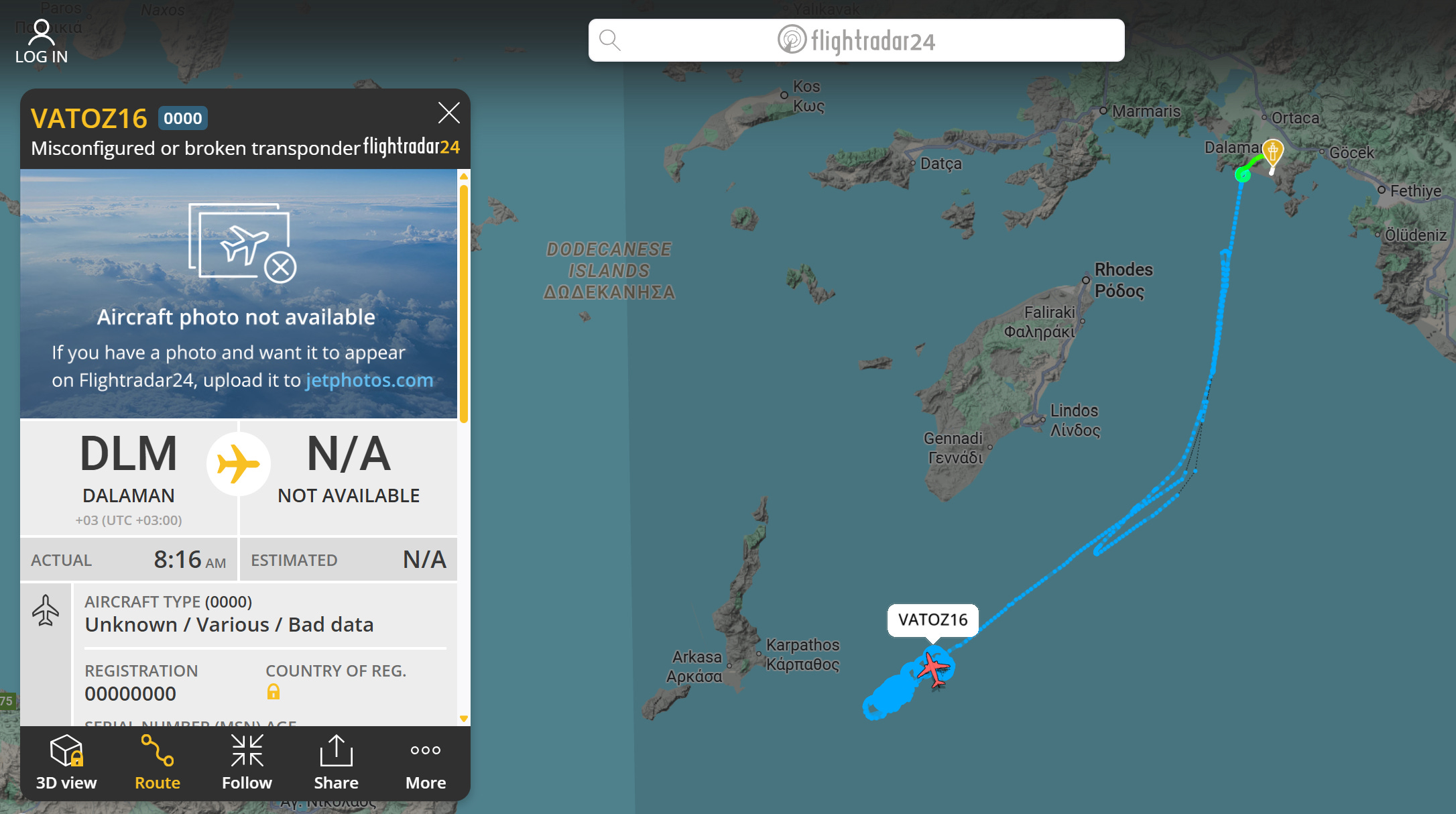
Turkish drone violations of the Athens FIR under the pretext of monitoring the Gaza Sumud flotilla (27.9.2025). Notice that the “VATOZ16” UAV appeared to be monitoring the Karparthian straits, site of the July 2024 crisis, when Turkish warships blocked a Greek-leased survey ship from conducting surveys in the area for the laying of the Great Sea (Euro-Asia) Interconnector cable, designed to connect the electric grids of Greece, Cyprus and Israel.
October 1, 2025: Greek Wings over Nicosia:
Two HAF F-16s performed a low-attitude pass over the Nicosia military parade on October 1, marking 65 years of independence for the Republic of Cyprus from the United Kingdom. While it’s not the first time that Greek wings have flown to Cyprus in recent years, with a historic tour de force in August 2020, when six Greek F-16s landed in Cyprus for the first time since 2000, amidst near-war tensions with Turkey over the latter’s survey ship mission in disputed maritime zones of the Eastern Mediterranean, the symbolic fly-over was yet a pointed reminder of Greece’s extended deterrence over the free Republic.
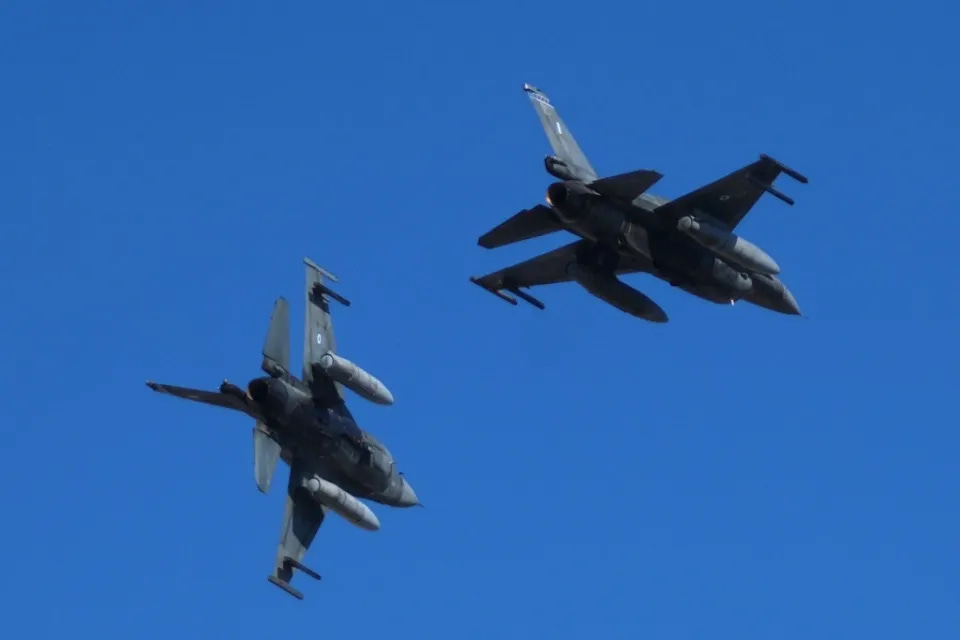
While the Greek doctrine of Joint Defence Area (also known as Single/Common Defence Space), developed as a unified deterrent strategy across the Aegean and Eastern Mediterranen and the joint Greek and Cypriot continental shelves, waned down following the 1996 Imia crisis and the 1999 Greek-Turkish rapprochement, the defence concept still echoes in light of HAF’s and the Hellenic Navy’s ongoing modernisation programmes. Just before the doctrine’s formulation in 1993, successive Greek governments throughout the mid-1980s had established a casus belli (cause of war) against any attempts by Turkey to expand its occupation zone in Cyprus. In the words of Prime Minister Andreas Papandreou in a 1987 address before the Hellenic Parliament:
“In order to avoid misunderstanding, it should be known to friends and foes alike that in case of an attack or invasion against the Greek-Cypriot positions, Greece will not stay out. I have warned that this is a casus belli. We hope that our partners in EEC and our allies in NATO will understand the sincerity of our decision to defend Cyprus because if Cyprus is lost, Greece eventually will be lost.”
October 1, 2025: Kastellorizo, Dodecanese:
Throughout 2022 and on a few occasions in later years, Turkish President Erdogan’s bellicose rhetoric against Greece evoked jingoist images of sudden night raids targeting the east Aegean islands, whose partially demilitarised status, as per the 1923 Treaty of Lausanne, does not meet Turkey’s demands of total demilitarisation. In his own words, the Turkish President stated on multiple occasions that Turkey “can come suddenly one night”, a threat that he has since also levelled against the Kurds of northern Syria and the State of Israel.
The President’s allure to nightly visits comes from a twisted subversion of a Turkish love song, based on Ümit Yaşar Oğuzcan’s poem “Don’t call me so heartily/I can come suddenly one night”, which made for the unofficial soundtrack of the 1974 invasion, when it played prominently in Turkish and Turkish-Cypriot radio stations as the invasion force landed. Thirteen years earlier, during the 1963-64 period of intercommunal violence, Greek-Cypriot radio stations would mockingly play another Turkish song, “Bekledim de Gelmedin/I Waited but You Never Came”, to psychologically demoralise and taunt the Turkish Cypriots in light of Turkey’s invasion threats at the time. The same kind of psyop then played out in reverse in 1974, when the Turkish radio sang of love and nightly romance while a mass rape and sexual abuse campaign targeted Greek-Cypriot villages and towns.
As verified by the European Commission of Human Rights and the Cyprus v. Turkey cases (Applications nos. 6780/74 & 6950/75), rape was routinely weaponised by the Turkish army to break civilian resistance and punish the Greek-Cypriot population in a “wholesale and repeated” manner.
Additionally, a 1995 report submitted before the UN Commitee on the Elimination of Discrimination Against Women also attested that while until 1974 abortions were illegal in Cyprus, “after the Turkish invasion of Cyprus and the rape of many women by Turkish troops, abortion was legalized in the following instances: (i) When it is proved […] that a pregnancy is the result of rape […] (ii) When the pregnancy […] will affect either the physical or the psychological health”. The weaponisation of sexual violence in the Cyprus invasion mirrors a similar pattern witnessed in the Turkish army and gendarmerie’s anti-PKK operations in Kurdish-majority areas of southeastern Turkey, with the case of Aydin v. Turkey amongst the most notable.
Mr Erdogan’s contemporary allusions to the song’s lyrics continue to function both as a coercive threat and a psychological operation tool at the highest political level. Knowing full well the Greek media’s obsession with the Turkish President’s public statements, repeated and dissected multiple times at morning news shows on a daily basis by the likes of SKAI news channel, the Turkish Presidency’s Communications Directorate must not have been able to resist the temptation.
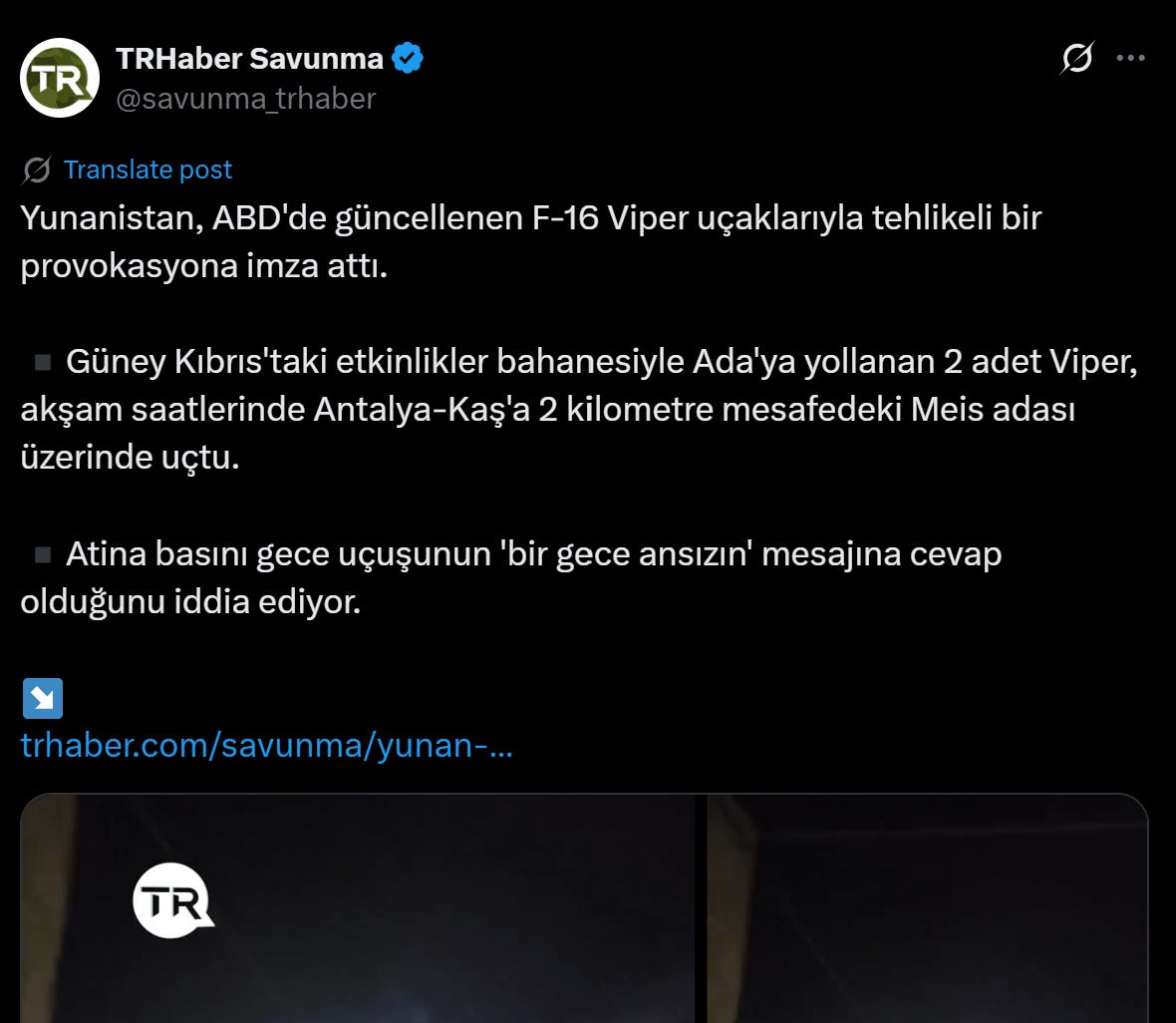
While the threat of a new Turkish invasion, evoking the Cyprus experience, has been periodically repeated since 2022, HAF’s latest response came with an F-16 night drill over the frontier island of Kastellorizo.
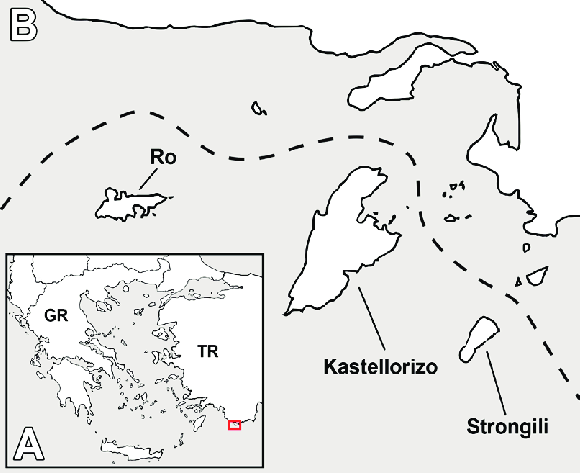
At just 1 mile (2 km) off the Anatolian coast, across the coastal town of Kaş, and 83 miles (135 km) east of Rhodes, Kastellorizo is the easternmost Greek territory and one of the many East Aegean isles framed by Turkey’s bellicose rhetoric. The symbolic choice to conduct the overflight, part of the Hellenic Armed Forces’ annual “PARMENION” exercise, in the early morning hours of October 1 on Cyprus’ Independence Day, followed by HAF’s participation in the Nicosia parade, was a clear signalling attempt of Greek deterrence at home and in Cyprus.
Notably, the Turkish press seemed to appreciate the intended message as a response to the President’s veiled threats of nightly escapades.
The F-16 Viper:
The Greek F-16 fleet numbers 152 aircraft, 83 of which are currently undergoing the Block 70/72 Viper modernisation programme by Lockheed Martin, set to conclude by 2027. 42 F-16 Vipers are currently in Greek hangars with the latest upgraded jet having been delivered on September 23, 2025, marking the halfway point of the Hellenic Air Force’s (HAF) fleet modernisation.
The Viper modernisation sees critical upgrades in the aircraft’s radar range, avionics, electronic warfare suites, weapons’ stores and mission computer, as well as enhanced cockpit tactical displays with optimal sensor data fusion and hence greater operational awareness.
The Viper fleet’s capabilities and compatibility with the F-35 squadron, which HAF will start receiving in late 2028, bestow a considerable qualitative edge to Greek wings, which will boast 107 4.5-generation fighter jets, consisting of 24 Rafale aircraft and a total of 83 F-16 Vipers.
Finally, concerning HAF’s enhanced night ops capabilities, the Viper modernisation offers full Night Vision (NVIS) compatibility with the Joint Helmet-Mounted Cueing System II (JHMCS), which allows the pilot to acquire and engage targets with greater ease in low-light conditions and decreased dependency on visual references. To that end, the APG-83 AESA radar supports those systems’ optimal performance in low-visibility conditions through its advanced air-to-air and air-to-ground detection, high-resolution ground mapping, synthetic-aperture imaging (SAR), and superior moving-target tracking capabilities that outmatch those of earlier F-16 Block variants.
In short, the F-16V is suited for both day and night deployments, the kind of which Mr Erdogan seems to be most fond of, and HAF is keen to remind that.